New Website

Leave a Comment

I am excited to launch an all-new It Takes Time! This updated and revised site offers new recipes, tutorials and suggestions for making healthy change -all in the context of less pressure. Check out It Takes Time here.

I began my Mold Recovery blog in 2008 as a means to keep others updated about our journey - a journey that began soon after we made the connection between our health issues and toxic mold. I soon sensed a need to share more than our journey as many others were experiencing issues due to toxic mold.

My area of interest has expanded to include issues surrounding food, pesticides, and healthy living in general. I'd love to have you join in the journey! Subscribe to stay in the loop of what's happening with It Takes Time.

It Takes Time Updates

* indicates required


Read More...

Cheap and Effective Body Care

Leave a Comment


Baking soda is the ultimate cheap, safe ingredient for beauty care. I recently listed 4 ways to use baking soda  over at Adrienne's Whole New Mom. One of my favorites is microderm abrasion.Stephanie Tourles, author of Organic Body Care, says this recipe rivals expansive spa treatments.

Stephanie’s Secret Microdermabrasion Recipe:
Ingredients
1 Tablespoon baking soda
1.5 teaspoons water
2 drops helichrysum essential oil
Method
1. Combine in a bowl until you have a velvety slurry.
2. Dip the pads of your fingers into the slurry and lightly massage your face and throat. Do not use much pressure. The granules of the baking soda will do the exfoliating work.
3.  Continue to dip fingers into the slurry until the entire skin is covered with a thin coat.
4.  Rinse and pat dry.

To find out the other 3 ways to use baking soda in your personal care see

Helichrysum essential oil is expensive but it will last for more than a year. Helichrysum promotes wound healing, stimulates digestion, boosts the immune system and much more. I buy mine here.

To see the other three tips for using baking soda in your beauty care see Is THIS Amazing Ingredient Missing From Your Natural Beauty Routine?


Read More...

Sifting Through Sugar

Leave a Comment
Do you find yourself confused by the different options for sweetening your food? Wondering if unrefined sugar is truly better than refined white sugar? Is honey better than agave? How about xylitol or stevia?

One of the key considerations is the amount of fructose, which gives food its sweet taste. Fructose makes up 50% of table sugar, and occurs naturally in fruits and even some vegetables.

Fructose, like alcohol places a burden in the liver. Unlike alcohol, fructose kicks the liver into fat storage mode, which can lead to insulin resistance and obesity.
 The resulting metabolic syndrome is perceived as a lack of discipline or willpower, when in fact the problem is biochemical.

The key it seems is keeping sugar in its place. . Historically, sugar has been considered a special treat rather than an entitlement. Dr. Robert Lustig, author of Fat Chance, Beating the Odds Against Sugar, Processed Food, Obesity, and Disease says it's best to stick with fructose in its natural form.

"Naturally occurring fructose comes from sugarcane, fruits, some vegetables, and honey. The first three have way more fiber than fructose, and the last is protected by bees. Nature made sugar hard to get. Man made it easy to get."

We made it very easy to get when we invented high fructose corn syrup in the 1970s. HFCS is processed with chemicals such as caustic soda (which may or may not contain mercury), alpha-amylase, hydrochloric acid, and isomerase, using corn (likely to be genetically modified) as its substrate. The corn starts out with no fructose, but after the enzymatic process yields a substance that is 55% fructose and 45% glucose. Clearly, HFCS comes with a set of risks.

However, the fructose content is virtually the same as table sugar. Therefore, avoiding HFCS may be a good step, but not the solution.

Some of the highest concentrations of fructose occur in unexpected places. Fruit juice concentrate can go as high as 90%, depending on sugars added or the type of fruit used. Apple juice concentrate is about 70% fructose, while orange juice concentrate comes in at 50%.

Agave nectar is derived from the yucca family of plants and requires high amounts of processing to convert the root bulb into syrup. The process is not unlike the one used to convert cornstarch into HFCS. Depending on the process used, the fructose content can range from 55% to 90%.

The similarities between naturally occurring and manufactured sweeteners can be seen in the following graph:

What about artificial sweeteners?
Sweeteners like aspartame and sucralose (Splenda) are 100% chemically derived and thus present a challenge to our already overburdened cells. These chemical compounds easily cross the blood-brain barrier, carrying with them the potential to do neurological damage.

Unrefined sugars include sucanat, rapadura, and turbinado. Rapadura and sucanat are similar dehydrated sugarcane juice products. Both retain the molasses. Turbinado adds the extra step of removing impurities and surface molasses with a centrifuge.

Sugar alcohols such as mannitol, sorbitol, and xylitol are neither sugar nor alcohol, but do add sweetness. All three occur naturally in various fruits and vegetables; however, sorbitol is most often produced from corn syrup. These substances are not fully digested by the body and can  lead to abdominal pain, cramping, or gas.

Other options worth considering are stevia and lo han. Lo han is derived from the Chinese monk fruit, while stevia is an herb native to South America. Both can be found with varying degrees of processing, but do not carry the fructose burden common to other sweeteners.Keeping sugar in its place, unrefined or otherwise, can go a long way toward protecting our health.

Read More...

Our Kitchen: Then and Now

5 comments
Our kitchen table as we left it Oct. 4, 2008


When our family vacated our home in October of 2008 we left everything behind, including the contents of our spacious pantry. Because of legal action (which has since been dropped), we had our home inventoried. Every item in every room of our five-story home was accounted for and priced. The following is a partial list of the products in our pantry.
  • 1000 ISLAND DRESSING
  • ANNIES HOMEGROWN WHOLE WHT BUNNIES 5 OZ
  • ARCHER FARMS BLUEBERRY GRANOLA W/FLAX CER
  • ARCHER FARMS ORG. P-BUTTER CHOCO TRAIL MIX BARS 6 OZ
  • ASSURED FRESHNESS ITALIAN RICE
  • BACK TO NATURE P-BUTTER COOKIES 9 OZ
  • BARBARAS LITE RITE ROUNDS 11 OZ
  • BARILLA PECCALINI MINI PASTA 1#
  • BOBS RED MILL 10 GRAIN PANCAKE MIX
  • BOBS RED MILL GLUTEN FREE PANCAKE MIX
  • BOBS RED MILL ROLLED OATS 16 OZ
  • CAMPBELL SOUP
  • CAMPBELL SOUP LARGE
  • CAPRI JUICE 10 CT
  • CASCADIAN FARMS ORGANIC RASIN BRAN
  • CHEX MIX 15 OZ
  • CHEERIOS
  • CHEETOS 11 OZ
  • CHUNKY BLUE CHEESE DRESSING
  • CLIFF KIDS ORGANIC Z BARS 7.62 OZ
  • CRANBERRY SAUCE
  • DICED TOMATOES
  • EGGO SYRUP 23 OZ
  • EMERALD ALMONDS 11 OZ
  • FLORIDA NATURAL AWESUM FRUIT NUGGETS 14.4 OZ 14 POUCHES
  • GENERAL MILLS FIBER 1 PANCAKE MIX
  • HANSENS ORGANIC JR JUICE
  • HUNTS CATSUP 36 OZ
  • INSTANT RICE 28 OZ
  • ITALIAN DRESSING
  • JELLO INSTANT PUDDING
  • JIFFY CORN MUFFIN MIX
  • JOLLY TIME POPCORN 20 OZ
  • KEEBLER ICE CREAM CUPS 24 CT
  • KEEBLER TOAST & PBUTTER CRACKERS
  • KIKOMAN SOY SAUCE 20 OZ
  • KRAFT BARBQ SAUCE
  • KRAFT EZ MAC
  • MAC & CHEESE
  • MICROWAVE POPCORN
  • MUSTARD 14 OZ
  • ODWALLA BAR
  • OLIVE OIL 16 OZ
  • ORGANIC DICED TOMATOES
  • ORVILLE REDENBACHER POPPING OIL 16 OZ
  • ORVILLE REDENBACHER POPCORN 45 OZ
  • PAM 5 OZ SPRAY ORGANIC CANOLA
  • PAM 5 OZ SPRAY ORGANIC OLIVE OIL
  • PETITE DICED TOMATOES
  • PLANTERS TRAIL MIX
  • PRIVATE SELECT CORN TORTILLA CHIPS
  • PROGRESSO SOUP
  • QUAKER OATS YELLOW CORNMEAL
  • RANCH DRESSING
  • RITZ 1#
  • ROLD GOLD PRETZELS
  • SESAME OIL 5 OZ
  • SOUTHBEACH BARS
  • SPAGHETTI SAUCE
  • STACY SIMPLY NAKED BAKED PITA CHIPS 14 OZ
  • STOVE TOP TURKEY STUFFING
  • SUCCESS BOIL IN BAG RICE 14 OZ
  • TOWNHOUSE TOPPER CRACKERS 13.5 OZ
  • VILLA PASTA HAND CUT FETTUCINI 12 OZ
  • WORCESTERSHIRE SAUCE 15 OZ

As I look as this list, I clearly see our dependence on processed foods. Because of our health crisis, I was attempting to make some better choices with the addition of "natural" and "organic" products—but the food was still in a box or a can, with a long list of unpronounceable ingredients.

Re-learning to feed myself and my family has not been easy. I have stumbled along the way. But the subtle health improvements are undeniable, and the benefits of our unexpected journey unmistakable.

This post shared at Wellness Wednesdays.

Below is a tour of our kitchen now. The contrast reminds me that change doesn't happen overnight. It happens one box of Stove Top Stuffing at a time.

Read More...

Shampoo-less and Proud

Leave a Comment


I haven't used shampoo for 4 years. I’d like to keep this a secret from TODAY's Kathie Lee and Hoda, however. If they find out they might laugh and ridicule me like they lambasted Jacquelyn Byers.

Jacquelyn has written about her decision to stop using shampoo on her blog Little Owl Crunchy Momma. The media picked up on  her chemical avoidance, including NBC's TODAY show. Before you continue, view this 2 minute conversation on TODAY's Health Page.

(*Kathie Lee and Hoda's exchange is the second video on the page. The clip starts at 6:40 mins.)

I understand that Kathie Lee and Hoda are personalities,and are encouraged by their producers to engage in negative chatter, but the segment saddens me for a number of reasons.

1. Jacquelyn is a real person with real feelings. She is doing her best to raise her kids in a chemically crazed culture. She's even trying to help others do the same. Kathie and Hoda, even if you don't understand her perspective, must you demean a young mom in this way?

2. Their conversation perpetuates the belief that chemicals have no consequences. We've been told we need to use multiple personal care products every day. Our generation represents a giant experiment when it comes to the use of chemicals on our bodies,and ills like endocrine disruption. Skin flora erosion and cancer are now linked to petroleum based substances such as DEA, 1-4-dioxane, and toulene.

3. I relate to Kathie Lee and Hoda. I might not have said it, but I thought people like Jacquelyn (and now me) were crazy. I dismissed them. I viewed them with disdain. Only my family's health crisis led me to re-evaluate my presumptive conclusions. Watching Kathie Lee and Hoda reminds me that I can be, and have been, insensitive and oblivious to the feelings of others.

4. Most women in the world can't afford perfume and personal care products. The average American woman uses 12 different products every day according to the Environmental Working Group. The average teenage girl uses 17. While affordable to most in America, women around the globe are too busy struggling to survive and care for their children.

The one person I don't feel sad for is Jacquelyn. While I'm sorry she had to endure this type of treatment, I'm confident she is ahead of the game. Thinking outside of the box for herself and her family will yield great benefits. I hope her blog grows by leaps and bounds because of this publicity.

Meanwhile, I’ll keep washing my hair with mud. I say mud because I use rhassoul clay and that's what it feels like when I mix it with water. But again, please don’t mention this to Kathie Lee or Hoda. Oh, and between you and me, my hair has never felt better, and no one has complained of any odor.

See more about rhassoul clay in this post, and more about natural shampoo alternatives here.

This post shared at Wellness Wednesday. Natural Living Monday Simply Natural Saturdays, Simple Saturdays
Read More...

Culturing in the Cold

Leave a Comment


If you make foods like sauerkraut, kefir and kombucha, chances are you've noticed a change in the way your foods culture during the winter. Cooler indoor air temperatures can slow the growth of  the bacteria and/or yeasts. Optimal temperatures vary, but most microbes enjoy what we enjoy - in the mid 70s to 80. I don't know about your house, but our house frequently goes below 70 degrees in the winter.

Before I discovered the technique pictured above, I noticed a much sweeter taste in my water kefir, letting me know that my grains were struggling. I had two choices - either lengthen the time of fermentation, or increase the temperature. I added the heating pad and my water kefir has returned to its usual tang.

Since my heating pad is new, the lowest setting works best. Older heating pads may work best at the medium or high settings. I ordered one without the automatic shut off since I don't want to worry about keeping it on. I found mine here.

(I like keeping a heating pad on my kitchen counter for another reason. It facilitates easy melting of my coconut and red palm oils, since they harden during the winter.)

A heating pad isn't the only solution for culturing during the cooler months Other options include:
  1. Increased elevation.  If you have a higher shelf in the kitchen, the yeasts and bacteria will enjoy the warmer spot.
  2. Oven light.  Some oven lights reach a temperature that is too high. Check yours before trying this method. If the temperature is not too high, this can be a great method.
  3. Seedling mat. These work similarly to the heating pad, offering warmer temperatures under the jars. 
  4. Dehydrator. You can place the jars next to a dehydrator that is in use or try putting the jars inside the dehydrator. Again, check the temperatures to avoid overheating.

Wondering about cross contamination with all of your ferments in one small location?  In his book, The Art of Fermentation, author Sandor Katz addresses the issue,

" I cannot guarantee that cross-contamination among cultures is impossible, but it is not a likely occurrence,and I encourage enthusiastic experimentalists to ferment to your heart's content with out worry of cross-contamination."

With these simple temperature control suggestions why not ferment to your heart's content this winter?

This post shared on Healing with Food Fridays

Read More...

A Toxicologist Looks at Mold Remediation

Leave a Comment

The book of Leviticus makes it clear that if mold is still present after remediation, the home is unsafe. This is a radical approach to mold, one shared by leading toxicologist Dr. Jack Thrasher. Dr. Thrasher, author of the article The Biocontaminants and Complexity of Damp Indoor Spaces: More Than What Meets the Eyes, says it is best to flee a home rather than remediate when serious health issues exist and when a serious infestation is involved. According to Dr. Thrasher:

I have always been skeptical regarding the successful remediation of homes and buildings contaminated with fungi and bacteria from water intrusion. Buildings and homes are complicated structures. The spores of both bacteria and fungi, as well as their by-products (fine particles less than one micron to those equal or greater than the mold spores), are present in dust. The dust can be found in all nooks and crannies of a building, e.g. refrigerator insulation and coils, areas not normally dusted, even in carpeting that has been vacuumed, under carpeting, and in wall cavities. Finally, little attention is paid to the contaminants in buildings that result from Gram negative and positive bacteria.

I will give some examples below:

  1. Two buildings in Bermuda. These buildings had been remediated prior to our testing. Also, just before we arrived to do testing, the buildings had been cleaned and painted. Aggressive air sampling revealed the presence of hidden fungal spores up to 150,000 spores per cubic meter. Q-PCR revealed the presence of Stachybotrys and several species of Aspergillus and Penicillium, along with other fungi. Culturing for presence of bacteria revealed pathogenic Gram negative and positive bacteria. Interestingly, the occupants of one building had recurrent episodes of food-like poisoning (diarrhea and lower abdominal cramping and pain). In this building we detected high levels of Bacillus cereus, a bacterium that causes food poisoning. Also, we found high concentrations of endotoxins (lipopolysaccharides) released by Gram negative bacteria. Moisture measurements revealed moisture content of walls from 58% to 98% in both buildings. Finally, disturbing the air around a work station that had computers produced spores of Stachybotrys at 7,000 per cubic meter. Thus, workers pounding on keyboards most likely were inhaling these spores along with finer particulates. Samples of dust were positive for endotoxins and 2-3-beta-D-glucans.

  2. House that had been remediated twice. The occupants were still ill. Moisture measurements showed moisture was coming up through the cement slab, which had numerous cracks. This was in all rooms of a 4-bedroom home. Q-PCR revealed Stachybotrys, several species of Aspergillus and Penicillium in three different dust samples (carpeting, living area, kitchen cabinet dust). Results for endotoxins were elevated. Mycotoxins were detected in the dust. Two windows had evidence of elevated moisture content below the window. Tests revealed wall cavity fungi that were active and grew when cultured. Gram negative and positive bacteria were cultured from dust. The fireplace area with a TV alcove had high moisture content with Stachybotrys present (this had been previously remediated). The master bath still had high moisture content with Stachybotrys isolated (this had been remediated). The moral of this story is to check cement slabs as well as check below every window in the home.
  3. I have done other homes with similar results. I always culture for bacteria and endotoxins, test for mycotoxins, and do Q-PCR on several different dust samples. We have to remember that air spore counts alone do not tell the story. The fine particulates (less than one micron) have been shown to be up to 500 times more concentrated than the airborne spores. The fine particulates contain the antigens and toxins. Finally, recent peer-reviewed literature has shown that the bacteria in water-damaged structures also release toxins into the indoor environment. Therefore, both bacterial and fungal toxins are present and should be considered in risk assessments with respect to animal and human health.
As for the implications of this for those who are genetically challenged, Thrasher says:

People who are genetically challenged would be those who are genetically susceptible to such exposures. This would involve not only HLA genes but also genetic polymorphism of detoxification pathways such as Glutathione transferases and Cytochrome P450. Thus these people should receive full disclosure when renting or buying.
Read More...

Boost Your Immune System with Fermented Turmeric

Leave a Comment


Turmeric is getting lots of attention these days because of its potential health benefits. Not only has the curcumin component of turmeric been shown to have anti inflammatory benefits, it has been associated with the inhibition of colon, gastric, and breast and skin cancers

Can adding turmeric spice to tonight’s dinner give you all these benefits? Perhaps not. If a substance is poorly absorbed, has a high rate of metabolism, or is rapidly eliminated it is considered a substance with low bioavailabity. Curcumin fits this profile. (For more see the article “Bioavailability of Curcumin: Problems and Promises.”)

So while it won’t hurt to sprinkle powdered turmeric on your favorite dish, there may be more effective ways to integrate turmeric into your diet.

One option is to ferment this nutritional powerhouse. A study published in the International Journal of Food Science and Technology found that the bioavailability of turmeric increased in rats when it was fermented. According to the study,

“Plasma antioxidant concentration was higher in rats administered fermented turmeric beverage than other turmeric products. . . “

How can we ferment turmeric? One option is to make a “turmeric bug.” This is similar to the ginger bug used frequently for beverages like ginger soda. The process is quite simple and a great choice for those new to fermentation. Grate raw turmeric, combine with water and sugar, and place on shelf away from direct sunlight. Continue to feed the blend with more sugar and turmeric until there are signs of fermentation. Turmeric powder may be substituted for the raw turmeric.


For detailed instructions see “How to Make a Turmeric Bug.”

What can you do with your turmeric bug?

1. Turmeric Lime Soda

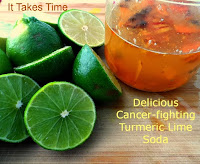
This is a family favorite. With a hint of turmeric flavor and a nice burst of lime this probiotic beverage is full of immune boosting punch.

For detailed instructions see Delicious Cancer-fighting Beverage: Turmeric Lime Soda.

2. Beet Kvass with Turmeric

Beet kvass is a wonderful cleansing tonic. Typically beet kvass is made with chopped beets, filtered water and salt. Whey is often used a starter. Why not substitute a turmeric bug for the whey, or add turmeric root along with the beets?

For detailed instructions see How to Make Beet Kvass.

3. Turmeric Gelatin

Once you find a turmeric beverage you enjoy, it’s simple to transform into a delectable gelatin treat. Whisk 2 cups fermented turmeric beverage (or turmeric bug) with 1.5 tablespoons Gelatin. (I prefer naturally derived gelatin sourced from grass fed cows.) Heat the mixture to allow the gelatin to dissolve thoroughly. Add honey or stevia for added sweetness.Pour into mold and refrigerate.

4. Fermented Ketchup

I take my favorite ketchup recipe and add 1/2 cup turmeric bug to ferment the blend for a couple of days. The turmeric adds a nice twist to the spicy flavor. View the ketchup recipe here.

With all of its medicinal properties, fermented turmeric offers a welcome addition to any kitchen.

This article shared at Healing with Food Friday, Mostly Homemade Mondays, Wellness Wednesday, Friday Favorites


Read More...

One Step at a Time

Leave a Comment
Peg's kitchen lab: raspberry vinegar, kefir, and turmeric bug - alongside her new dehydrator!
Hoping to live healthier in 2014?  I hope Peg's story encourages you. (Peg and her husband Ron are active retirees here in Arizona.)

What a difference a year makes!  A year ago, January of 2013, I began attending fermentation classes offered by Andrea Fabry.  The information regarding how our bodies work and  what’s needed to maintain natural health was, literally, life changing.  Thus started my quest to begin making changes that might encourage a healthy gut.

Reflecting on the past year, I surprised myself with the changes.  While I thought small changes were being made, I realized I’d made kefir, kombucha, sauerkraut, laundry soap, sunscreen, and shea cream. I bought and used a number of essential oils, started dry body brushing, began buying some organic foods, bought a dehydrator and have probably missed something.  I have incorporated healthy oils, grains, nuts, sweeteners, etc. all without much thought and have had fun in the process.  My pantry certainly looks different than it did one short year ago!

It has been quite a journey.  For anyone thinking about making healthy changes, it’s well worth the effort. AND my husband has enjoyed the changes! In fact, just this week Ron's dermatologist asked what he's doing differently because his skin looks so much better.

As for expense, I'm surprised how affordable these changes have been. Once you have things on hand, they go a long way!

Need help making healthy lifestyle changes? Consider joining momsAWARE's Natural Year Challenge.

If food is your area of interest, why not take the momsAWARE Natural Year Challenge:10 Steps to a Healthy, Natural, and Flavorful Diet? Each step involves one project per month. You even have two months to take a break or catch up!

If reducing chemicals in your home is an area of interest, we offer the momsAWARE Natural Year Challenge:10 Steps to a Naturally Clean Home.

Don't miss out. There is no charge to join, and,who knows, your kitchen and home may look very different a year from now!
Read More...

Soy, Vitamin K2 and Natto

Leave a Comment

Natto is a traditional Japanese food made from soybeans fermented with the microbe Bacillus subtilis. It is one of Japan's most noteworthy health foods.

But isn't soy bad for me?

 Lots of controversy surrounds the issue of soy in our diet. The rise of genetically modified soy adds to the problem. (93% of all soy in this country is genetically engineered.)

The issue with soy in its natural state is that it contains various anti-nutrients that present problems for the immune system.These anti-nutrients help protect the bean from the sun's radiation and microbial invasion, but work against the people interested in consuming soy.

Soy's anti-nutrients:

Phytates:  All beans contain phytates (or phytic acid). Soaking typically removes most of this, but soybeans are particularly stubborn in this regard. Fermentation offers an extra boost.

Enzyme inhibitors: Enzymes digest our food. When enzyme inhibitors are present, enzymes can't do their job. This leads to gas and bloating, as well as a host of other issues. Soaking usually solves this, but again the fermentation helps the process along.

Goitrogens: These substances potentially block production of thyroid hormones. Many people avoid soy simple because of the goitrogens.

{It's important to note that fermented soy does not take care of the goitrogen issue. Sugar separates from the goitrogens during fermenation, so goitrogens may actually be increased. The good news is that a healthy thyroid should handle this. Some suggest consuming foods high in iodine to counter the goitrogen effect.Others suggest using alternative beans like navy beans or black beans. Still others suggest keeping fermented soy consumption to a minimum. Certainly less may be more when it comes to fermented soy.}

Fermented soy offers unique health benefits.

Soy in forms such as tempeh, miso and natto are rich in the fat-soluble vitamin K2. Of the three, natto is the richest source. Vitamin K2 is closely connected with the health of our bones, teeth and overall immune system.

Health benefits of vitamin K2.
  • Protects against heart disease
  • Helps ensure healthy skin
  • Contributes to strong bones
  • Promotes brain function
  • Supports growth and development
  • Fights against cancer
To learn more about the immune boosting properties of vitamn K2, I recommend the book, Vitamin K2 and the Calcium Paradox. Author Kate Reheaume-Bleue offers an excellent explanation of why calcium supplements are coming up short in the fight against osteoporosis and why adult women are in need of vitamin K2.

While vitamin K2 is a recent discovery, it's important to note that researcher Dr. Weston Price became aware of  its benefits while studying dental health and diet in the 1930's. Dr. Price found that primitive people groups with the healthiest teeth consumed traditional foods rich in a mystery compound he termed Activator X. We now know it as vitamin K2. (For more on Dr. Price's research see On the Trail of the Elusive X-factor: A Sixty-Two-Year-Old Mystery Finally Solved.)

Convinced about vitamin K2? Look what natto has to offer!


*The butter in this graph refers to standard butter rather than butter from cows raised on fast growing grasses.*The egg yolk statistic does not reflect pastured chickens raised in the outdoors.  In both cases, vitamin K2 levels would be higher, but not nearly as high as natto.

Want to add natto to your diet? Here are some options.

Store-bought natto.  Most Asian markets carry natto in their frozen food section. The flavor packets contain numerous additives. These can easily be tossed. The natto in the styrofoam package typically has lots of strings, which indicates proper fermentation. It is not clear whether or not the soybeans have been genetically modified unless you purchase a brand like MegumiNATTO which offers a non-GMO version. Find out if megumiNATTO  is sold in your area here.

Natto in supplement form. Vitamin K2 comes from two sources: animal and bacteria. The  K2 found in grass-fed meat, egg yolks and butter is called menaquinone-4 or MK-4. If this appears on the label it is likely synthetic. Vitamin K2 in bacterial form has a range of MK-5 through MK-10. MK-7 is the one found in natto, and the one you'll typically see on supplement labels.  Amazon offers these varieties of vitamin K2 supplements.

Homemade natto.  Making natto from scratch is not as hard as it may seem. One of the biggest benefits is quality control. There are a number of farms that offer organic, non-GMO soybeans:

Laura Soybeans
Bob's Red Mill
Wheatgrass kits.

I have been making my own natto for 2 years, and have found a method that works for me. The recipe is outlined here.  I did not acquire the taste easily. Once I did, I found myself craving it. I'll typically have several spoonfuls daily along with a calcium supplement I make with dried eggshells. See more on the interplay between calcium and vitamin K2 in the article What You Need to Know About Vitamin K2, D and Calcium.

I also have found great benefit in applying natto to my face! My skin seems to soak up the vitamin K2 and other nutrients.

What is your experience with fermented soy? Have you tried natto?

This post shared at Nomday Monday, Healing with Food Friday, Gluten Free Fridays, Mostly Homemade Mondays

Follow my blog with Bloglovin
Read More...

Considering a Diet Change?

3 comments

Many of us are considering a dietary change, one with fewer processed, "boxed" foods. Perhaps chronic illness is a motivating factor. Or a child with behavioral issues. Or simply a general desire to eat healthier.

All sorts of doubts creep in when we make a decision to change. Doubts that keep us from taking action. Below are ten such doubts, along with ten truths to counter them.

  1. People will think I'm crazy.
    True.
    People also thought physician Ignaz Philipp Semmelweis was crazy when he suggested that hand disinfection played a role in the health of birth mothers. The connection between the food we eat and our health seems equally obvious, but anytime we go against the tide we are likely to experience ridicule and skepticism. This is simply part of the journey.
  2. It's expensive.
    True.
    The immediate costs may be higher, but the long-term costs are likely to be significantly lower as we save on doctor appointments, emergency room visits, and prescriptions.

    Colleen Huber, a naturopath, contends that eating organically is not necessarily more expensive. She did a comparison several years ago and found the two types of diet economically comparable. Her study can be found here.
  3. It might not "work."
    True.
    Dietary change seldom yields immediate results. Completely restored health is not a guarantee. But there is no guarantee with any change we make. Isn't it better to try rather than not try? Why not take the risk of eating healthier? If life gets better, and it likely will, healing may simply be honey on the flax cracker (so to speak).
  4. There are so many diets out there. They can't all be right.
    True.
    Some diets say juicing is good. Others say not. Some are vegan. Others are meat-based. Some are raw. Some are cooked. Some include sweeteners. Others do not.

    What do they have in common? No approach invites people to eat unlimited fast food, refined sugar, soda, and boxed food.

    Tthe confusion factor is one of the biggest hindrances toward altering our diet. This is where our intuition is a necessity. There is no "one size fits all" when it comes to diet. We're each unique, with our own specific needs.

    Don't be afraid to research, study, and ask questions. Be willing to make changes as you go along.
  5. It will be hard on my kids.
    True.
    It's also true that it is hard on our kids to continue to eat sugar and processed foods. The evidence for this is mounting. We can't protect our kids from pain; we can only do the best we can with the best explanation we can offer. If a child understands the reasons for the unusual foods, he/she may be more willing to try. Offer a trial period such as 30 days. It's often difficult for a child to think of giving up these refined/processed foods "forever."

    Try to find fun, creative alternatives for special occasions like holidays and birthdays.

    Our son with type 1 diabetes resisted the changes initially, but now offers a refreshing perspective. See Colin's post "Eating Healthy on the Road of Life."
  6. I might get sick.
    True.
    Sometimes the body is so worn down it doesn't let us know the food we're eating is doing us harm. If sugar is perpetuating some of the bad "bugs," we often don't know it. When our body "wakes up" and we start feeding it healthier foods, toxins can die and create die-off symptoms, which are often worse than the general feeling of malaise we may have started with. There are numerous ways to get through the die-off, such as Epsom salt baths, activated charcoal, vitamin C, and many others.

    If we're willing to get worse before we get better, we may eventually enjoy a whole new level of health.
  7. My food might not taste good.
    True.
    Diets high in processed foods "trick" the body into thinking it likes something, when in fact our taste buds are "dumbed down" rather than enhanced. Give new foods a try. Study the taste system and you'll find that we are designed for nutritional intricacy.

    Fresh dill pickles on a grassfed beef burger is a flavorful powerhouse because, according to Dr. Catherine Shanahan, author of Deep Nutrition:

    Though taste buds may taste one kind of flavor predominately, one bud can in fact detect different flavor ligands simultaneously. It turns out, the more, different kinds of flavors there are, the more we taste each one. When peptides and salt ions bind at the same taste bud, the result is not a doubling of flavor, but a powerful thousand-fold magnification in the signal going to your brain. . . . (This is why hot dogs, for instance—or better yet, actual sausage—taste better with sauerkraut and bittersweet mustard.)

    You may be shocked at the foods you will love! And how quickly the processed foods lose their appeal.
  8. Extreme dietary restriction isn't necessarily a good thing.
    True.
    Eating good, healthy, REAL food does not need to involve restriction. If you look at the ingredients in a fast food meal, you'll find that corn and soy are behind most of it. In his book The Omnivore's Dilemma, Michael Pollan breaks down the corn content of a fast food meal this way: soda 100% (since it consists primarily of high fructose corn syrup), milk shake 78%, salad dressing 65%, chicken nuggets 56%, cheeseburger 52%,and french fries 23%.

    In contrast, there are more than 70 types of vegetables, numerous varieties of animals, and lots of parts to these animals. There are an abundance of herbs and spices to flavor these foods.

    For some people, extreme may not be necessary. Eating less fast food and cooking more from scratch may be enough.

    But for those with severe illness, this quote from Hippocrates may apply: "Extreme remedies are very appropriate for extreme diseases."

    Sometimes a strong message to the body can lead to a big change.
  9. I don't think I can get my spouse or older children on board.
    True.
    We can't control others, in any area of life. We can, however, do our best to educate and explain. We can lead by example. We can try. A slow transition is often better than an abrupt, unwelcome change. Introduce one food at a time and try to find satisfying substitutes for their favorite foods. Ask for a family experiment. Initiate challenges. Make the change as exciting as possible.
  10. It will be difficult.
    True.
    There's simply no way around this one. It is hard to change patterns, food patterns especially. Good things don't come easily. There's no magic pill when it comes to health and diet. Convenience foods are just that: convenient. But there is something gratifying and empowering about this kind of hard work.
In summary, there are plenty of reasons to stick with the "old way." Plenty of reasons not to step out and try something new. This quote by Oliver Wendell Holmes offers some powerful inspiration:

I find the great thing in this world is not so much where we stand, as in what direction we are moving: To reach the port of heaven, we must sail sometimes with the wind and sometimes against it—but we must sail, and not drift, nor lie at anchor.

Today offers a brand new opportunity with infinite possibilities - the perfect time to set sail.


This post shared at Healing with Food Friday, Gluten Free Fridays, Allergy Free Wednesdays,                         

Follow my blog with Bloglovin
Read More...

Best of 2013 Cultured Foods and Beverages

Leave a Comment


It Takes Time has joined with a team of bloggers from the Alternative Living Network to bring you the best recipe and health posts of 2013.

I am hosting the best fermentation recipes, including my most popular post of the year: Turmeric Lime Soda.

Our family continues to enjoy the lime/turmeric combination. I have found I can make a turmeric bug with either raw turmeric or turmeric powder. For more see How to Make a Turmeric Bug.

To view the recipe, see Turmeric Lime Soda


I hope you enjoy the 2013 Best of Cultured Foods and Beverages!


Are you just beginning your fermentation journey? Water kefir is one of the easiest places to start. Just So Natural Products offers water kefir grains for $7.00. Visit the Just So online store to learn more.

Whether you're a novice or a pro, food culturing reaps great rewards. Happy fermenting in 2014!

Interested in other Best of 2013 posts?

Best Homemade Beauty Recipes on Your Thriving Family

Best Pregnancy and Birth Tips on Growing Slower

Best Pregnancy, Postpartum and Breastfeeding Tips on Feed Me Mama

Best Salads on Richly Rooted

Best Homemade Bread Recipes on The Entwife's Journal

Best Main Dishes on Whole Intentions

Read More...

Year-end Round up

Leave a Comment


As we close out 2013, I have some "best of" lists to share with you. This was compiled by Lexie at Lexie Naturals.

The following list is divided into different categories, and it contains the top 2 most popular posts from more than 20 different bloggers!  Enjoy!


(Mostly) Real Food Recipes

Caramel Pecan Cups by The Ezer Wife

Homemade Cajun Seasoning by Lexie:Naturals


Premade Pancake Mix by The Homesteading Hippy

How to Eat Organically On a Budget by Live Essentially


The Best Crockpot Granola by Home With Purpose

Make Your Own Almond Extract by The Homesteading Hippy


Slow Cooker Zuppa Toscana by Joyful Thrifty Home


Freezing Fresh Herbs by A New (England) Life


Healthy Cauliflower Tots by Healthy Jasmine


GAPS Diet Stories (And a Birthday Cake Recipe) by Purposeful Nutrition


Nanny's Oatmeal Chocolate Chip Cake by Home With Purpose


Quinoa Burgers by Hippie KarMama


Drink Recipes


Sparkling Apple Cider Vinegar Water by More Than Mundane


Turmeric Lime Soda by It Takes Time

Skin Care

Oil Cleansing Method by Natural Living Mamma

DIY Raw Honey Lip Salve by Nourishing Faith and Family

Ginger Lime Coconut Body Scrub by More Than Mundane

Natural Health


Gut-Restorative Diets by It Takes Time


Birth, Babies, and Children


The Home and DIY 


Simplify Your Wardrobe by Richly Rooted


Farm Girl Apron Tutorial From Recycled Jeans by Creative Green Living


5 Simple Tips for the Housekeeping Challenged by Noursihing Faith and Family


Enzyme Cleaner by Hippie KarMama

Organize Your Pantry with Glass Jars (plus free printable) by Creative Green Living


Life Without a Microwave by A New (England) Life


Make Your Own Baby Carrier by A Little Bit of All of It


Gift Giving


100+ Stocking Stuffer Ideas by Titus 2 Homemaker


10 Religious Easter Basket Ideas by Simply Rebekah


Faith and Encouragement


11 Free Online Devotionals and Bible Study Resources by Joyful Thrifty Home


Keep Calm, You're a Good Mom by Live Essentially


31 Days of Encouragement by My Blessings Homeschool


We hope that you enjoyed this round-up post!  Please remember that not all bloggers share the same platform or beliefs. Also, please be aware that some of these posts do contain affiliate links, at no extra cost to you. 

If you have a favorite blog post from this year, feel free to share it in the comments.

If you have a blog, we'd love to see your most popular posts in the comments!

Read More...